
Most shooters treat the reticle like a simple reference point. Put the dot on the target. Press the trigger. Repeat.
And while that works at a basic level, it leaves a lot of performance on the table. Because your reticle isn’t just a dot or a shape; it’s a measurement system. It’s giving you information about distance, hold, and alignment every time you look through your optic.
If you understand what it’s telling you, your shooting becomes more consistent, more predictable, and ultimately more effective.
At first glance, most reticles look simple.
A dot. A circle. Maybe a triangle.
But each of those shapes is designed with purpose.
Take a standard red dot, for example. When you see something like a 3 MOA dot, that size isn’t arbitrary. It represents a specific measurement: roughly 3 inches at 100 yards, 1.5 inches at 50 yards, and so on.
That means the dot itself can act as a reference for how much of the target you’re covering. At close range, it may feel precise. At distance, it may obscure more of the target than you expect. That’s not a flaw, it’s simply how angular measurement works. Once you understand that, you start to see the reticle as more than just a point of aim.
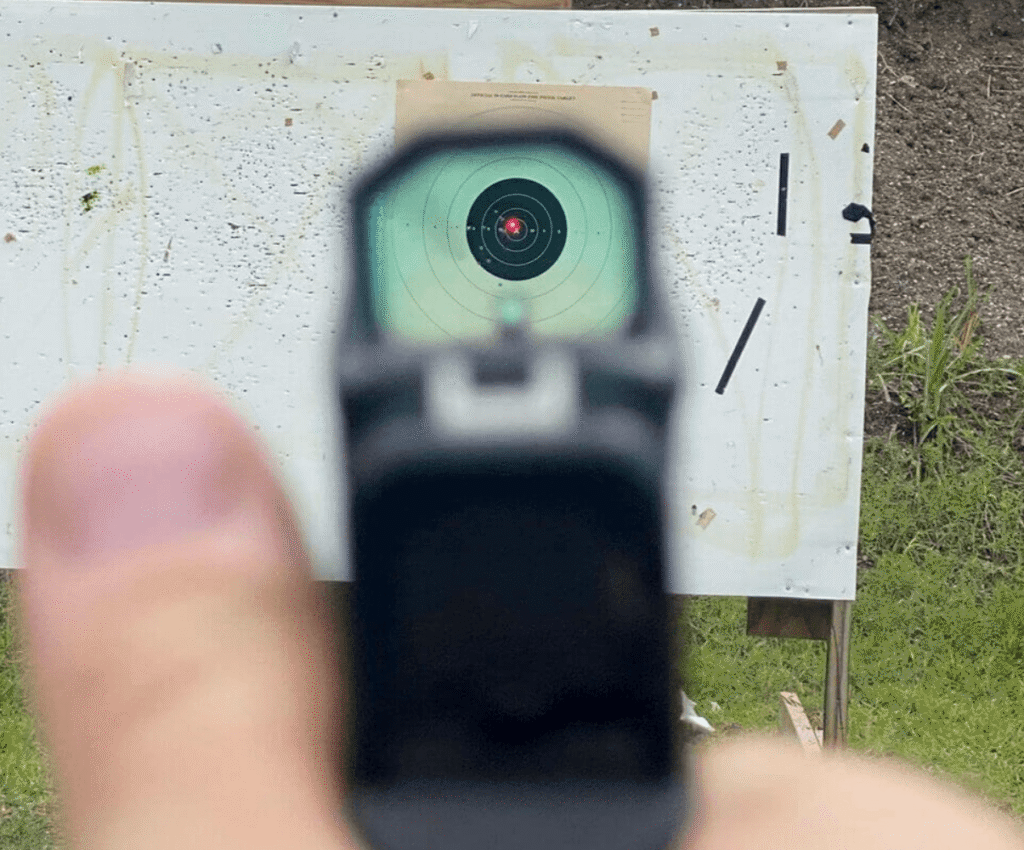
Dot size plays a major role in how your optic performs across distances.
A smaller dot, like 2 or 3 MOA, allows for more precise aiming at distance because it covers less of the target. A larger dot is faster to pick up, especially under stress, but sacrifices some precision as distance increases.
This is where many shooters get tripped up.
They expect one dot to do everything equally well. But like everything in optics, there are tradeoffs. Speed and precision exist on a spectrum, and dot size plays a big role in where your setup lands.
The key isn’t choosing the “perfect” dot size, it’s understanding how your current setup behaves and adjusting your expectations accordingly.
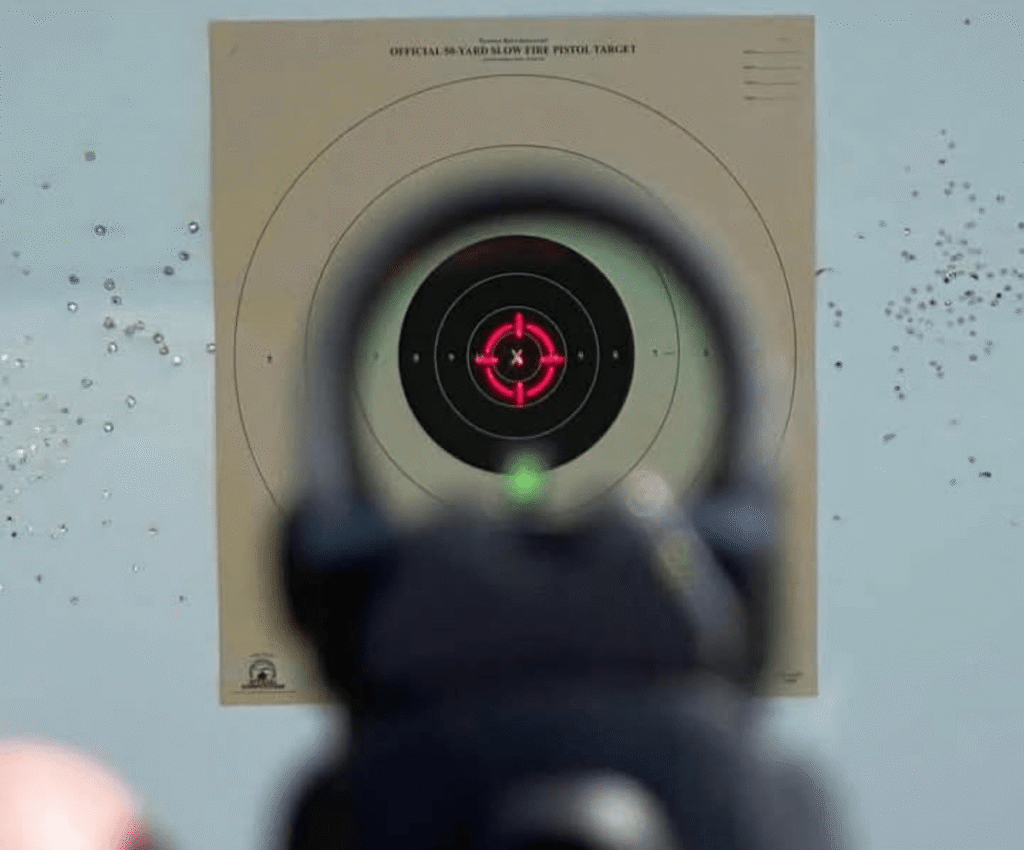
Circle-dot reticles add another layer of function. At first, the outer ring can seem unnecessary. But it serves a purpose: it helps your eye find the center faster.
At close range, your brain naturally centers the circle over the target, which makes target acquisition faster and more intuitive. You don’t have to consciously search for the dot, it’s already where it needs to be.
At distance, that same ring can become distracting. That’s why many optics allow you to switch between circle-dot and dot-only modes.
This flexibility matters. Up close, the circle helps with speed. At distance, the dot helps with precision. Understanding when to use each makes your optic far more versatile.
One of the most misunderstood aspects of using a reticle is how it relates to your point of impact, especially at close range.
Your optic sits above your barrel. That means your line of sight and your bullet’s path are not the same. At very close distances, your shots will impact below your point of aim. This is called mechanical offset. If you don’t account for it, you’ll consistently hit low at close range and wonder why.
The reticle helps you compensate for this. Instead of aiming directly at your intended point of impact, you adjust slightly, holding higher to account for the offset. The exact amount depends on your setup and distance, but the principle is always the same.
Your reticle isn’t wrong. It’s telling you exactly where the rifle is aligned, you just need to understand how the bullet gets there.
If your reticle looks distorted, fuzzy, or blown out, the issue often isn’t your eyesight or the optic itself. It’s brightness.
Many shooters run their optics brighter than necessary, especially in daylight. This can cause the reticle to bloom, making it appear larger and less defined than it actually is. Lowering the brightness sharpens the reticle and gives you a more precise aiming point. This becomes especially important at distance, where a crisp reticle allows for better shot placement.
Think of brightness as a balance, not a maximum setting. The goal is visibility, not intensity.
Different scenarios call for different uses of your reticle.
At close range, speed matters more than precision. Your focus should be on getting the reticle onto the target quickly and breaking the shot cleanly. Larger visual elements, like a circle-dot, help here.
At distance, precision takes priority. A clean, minimal reticle allows for more deliberate aiming and better shot placement.
This is why adjustable reticle systems are so useful. They allow you to adapt without changing your optic. But even with a fixed reticle, understanding how to use what you have makes a significant difference.
A reticle isn’t just something you look through. It’s something you use.
It tells you:
Ignoring that information limits your performance. Learning it unlocks it.
Most shooters don’t need a different optic, they need a better understanding of the one they already have.
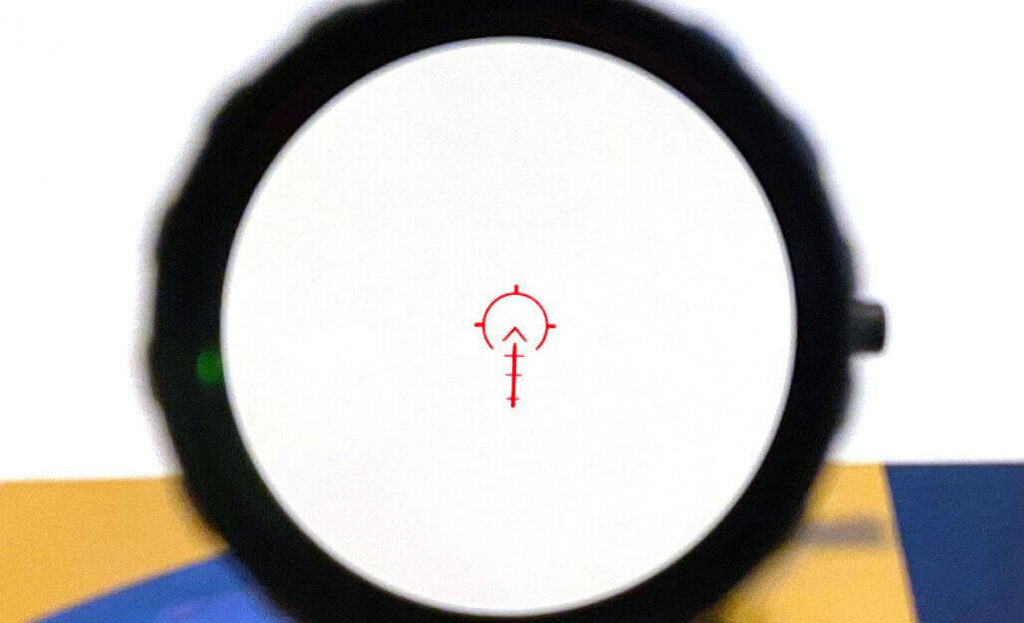
If you take the time to learn:
You’ll see immediate improvement in consistency and confidence. No upgrades required.
And if you’re running optics with more advanced reticle options, like circle-dot systems or etched reticles in prism scopes, those tools become even more valuable once you understand how to use them.
At a glance, a reticle looks simple. But it’s doing more than just marking a point.
It’s giving you information. It’s helping you make adjustments. It’s guiding your shot in ways that aren’t obvious until you start paying attention.
Once you understand that, everything gets easier.
You stop guessing.
You stop blaming the optic.
And you start shooting with intention.
If you’re ready to get more out of your setup, take a look at the Gideon Optics lineup and find the reticle that works the way you shoot.