
“Holds zero” is one of the most common phrases in optic reviews. It is also easy to misunderstand.
An optic that holds zero maintains its established aiming adjustment rather than changing unexpectedly. But seeing shots land somewhere different does not, by itself, prove that the optic has lost zero. Ammunition, mounting hardware, the firearm, shooting position, and the shooter can all influence where those shots land.
The useful question is not simply, “Did I miss?” It is, “Has the relationship between my aiming point and the resulting shot placement changed under comparable conditions?”
Understanding that distinction helps you evaluate a concern without immediately adjusting the optic, or replacing equipment that may not be responsible.
Zeroing establishes the relationship between an optic’s aiming point and the firearm’s point of impact at a chosen distance. You confirm that relationship through live-fire groups, making adjustments as needed.
Once established, the optic should retain that adjustment during normal use. That consistency is what shooters mean when they say it holds zero.
It does not mean every shot will land in the same hole. It also does not mean a firearm zeroed at one distance will strike exactly at the aiming point at every other distance. Zero is a reference established under particular conditions, not a promise that all shooting variables disappear.
There is another distinction worth remembering: an optic may retain its internal adjustment while something elsewhere in the setup changes. If the mounting system moves, for example, the aiming relationship can change even though the optic itself is not defective. Manufacturers therefore evaluate shifting impact as a shooting-system problem, not automatically an optic problem.
One unexpected shot provides limited information. A group gives you a better picture of where the firearm is placing shots and how much variation is occurring.
Manufacturers recommend evaluating several shots when checking point of impact rather than treating one shot as a complete answer.
Imagine that your usual group is centered near your aiming point, but one shot lands farther away. That result does not establish a zero shift. Now imagine that several comparable groups consistently center somewhere else. That is a more meaningful reason to investigate.
Pay attention to two different observations:
Group location: Has the center of the group moved?
Group spread: Have the shots become more widely dispersed?
These observations are not diagnoses. A shifted group does not identify the responsible component, and a larger group does not prove the optic is working correctly. They simply describe the concern more clearly.
“Three groups centered to the right of my previous baseline” gives you, and a support representative, more useful information than “the optic seems off.”
A suspected change is easier to evaluate when you have a record of the original result.
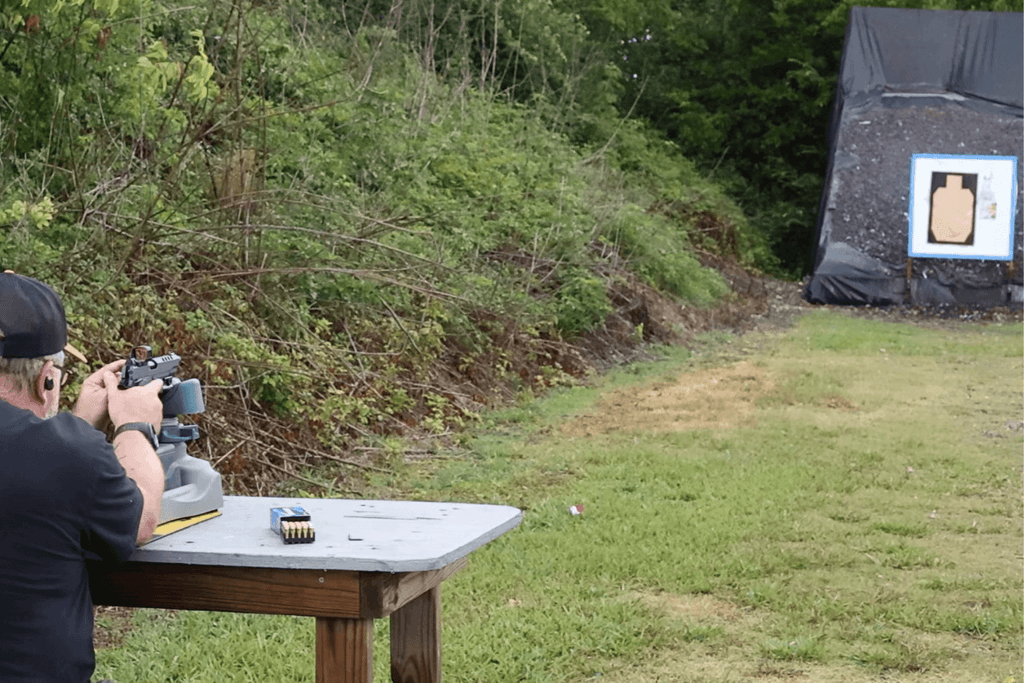
Keep a target or photo from the session in which you confirmed zero. Record the distance, ammunition, and relevant setup details. A note that says only “zeroed last month” leaves important questions unanswered.
Consistency matters when comparing results. Common troubleshooting guidance recommends using ammunition of the same bullet type and weight, preferably from the same lot, and a stable shooting support when evaluating point of impact.
For a useful record, document:
You do not need an elaborate spreadsheet. A labeled target and a few notes can provide a workable reference.
Without that baseline, normal differences between sessions can look like equipment failure.
Before deciding that the optic lost zero, compare the current session with the one in which you established it.
Did you change ammunition? Remove and reinstall the optic? Change a mount or plate? Use a different shooting position or rest? Make an adjustment and forget to record it?
These questions matter because shifting point of impact can originate in multiple parts of the system. Manufacturer troubleshooting guidance specifically identifies ammunition, the mounting system, the firearm, the shooter, and shooting position as possible contributors.
A change in ammunition, for example, makes the comparison less controlled. It does not automatically explain the result, but it introduces a variable you need to account for.
Likewise, a check at a different target distance is not a direct repeat of the original zero confirmation. Compare like with like before treating the new result as evidence that something moved.
The goal is not to find a reason to dismiss the concern. It is to determine whether you are evaluating the same setup under sufficiently similar conditions.
If the difference repeats under comparable conditions, resist the urge to adjust the optic, replace ammunition, retighten every fastener, and change your shooting position all at once.
Doing that may alter the result, but it makes the original cause harder to identify.
A more useful approach is to change one variable at a time and record what happens. That method is consistent with manufacturer guidance for diagnosing shifting point of impact.
Before inspecting mounting components, unload the firearm and follow its safety instructions. If you find visible movement, damage, or a questionable installation, resolve it before continuing.
Use the instructions for the actual optic, mount, plate, and firearm. Do not tighten screws beyond specification simply because you suspect movement. Manufacturer guidance calls for checking the mounting system against its specified installation requirements, not applying extra force as a substitute for diagnosis.
If the instructions are unclear or conflict, consult the manufacturer or a qualified gunsmith.
You may also see reviewers discuss whether a scope “returns to zero.”
Holding zero concerns whether an established setting remains consistent when no change is intended. Returning to zero concerns whether the scope reliably comes back to that reference after the shooter deliberately changes an adjustment.
That is why some scopes have zero-stop or locking features: they provide a defined reference for returning the elevation adjustment to its established position. The feature’s operation depends on the specific model.
Removing and reinstalling an optic raises a separate question about the repeatability of the mounting system. Do not assume that a previous zero remains confirmed simply because you put the optic back in the same location.
Being specific about what happened helps distinguish these situations. “The impact changed without adjustments” is a different report from “the impact changed after I removed the optic.”
You do not need to prove which internal component failed before asking for help.
Contact the manufacturer when the concern remains repeatable after reasonable checks, when you find damage, or when you are unsure how to proceed safely. A qualified gunsmith can also help evaluate the firearm and mounting system.
Provide the baseline and comparison results, the equipment combination, the ammunition used, and any recent changes. Include photographs where they help show the installation or targets.
Avoid disassembling the optic or attempting internal repairs. Follow the manufacturer’s support process and applicable warranty instructions.
For Gideon equipment, consult Gideon’s support and warranty information for the appropriate next step.
An optic’s ability to hold zero matters because you need confidence that its established adjustment remains consistent.
But that confidence comes from repeatable observations, not one unusually good group or one disappointing shot. Establish a baseline, make meaningful comparisons, and investigate changes methodically.
If your shots begin landing somewhere unexpected, take the concern seriously without jumping straight to a verdict. A clear record of what changed (and what did not) helps you identify the next step and gives the manufacturer better information if support is needed.