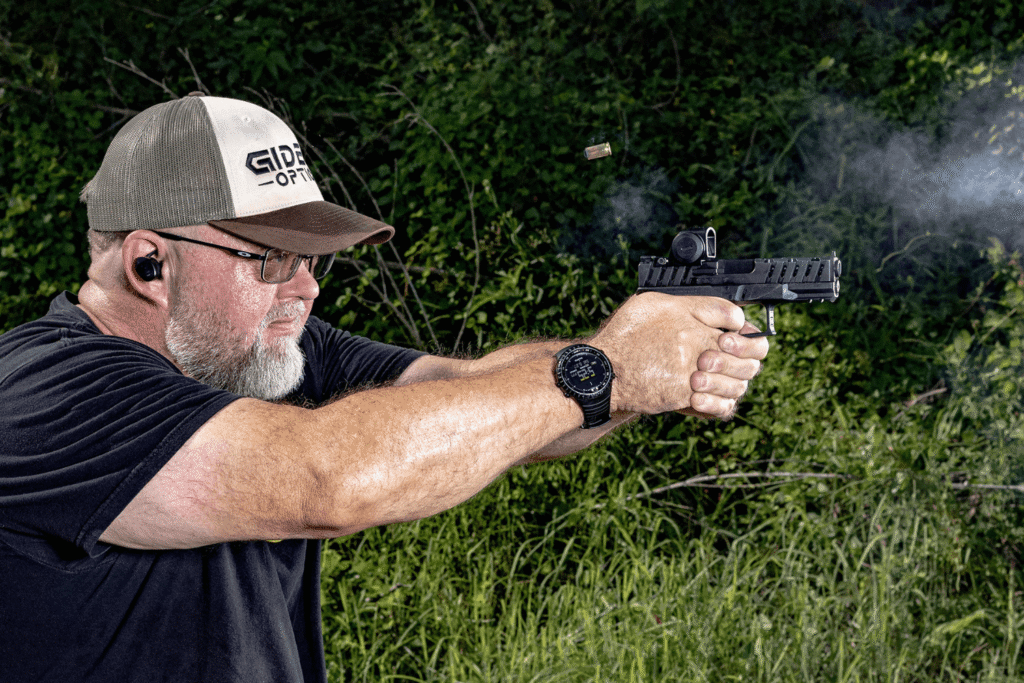

We build our pistol dots to be the best we know how to make; ready for real defensive use, ready for competition, and ready for the shooters who depend on them. But even quality optics live in the real world, where batteries die, glass breaks, dots get left off, and equipment can fail at the worst possible time.
When that happens, the answer is not to panic or give up. The answer is to know how to keep making accountable hits until the problem is solved.
Recently, Mike from Gideon Optics took a class with Erick Gelhaus of Cougar Mountain Solutions, focused specifically on what to do when a pistol-mounted red dot fails. The biggest takeaway was simple: skill and preparation still matter, and a quality optic works best when the shooter behind it knows how to fight through failure.
Before talking about failure, it’s worth stating the obvious: a working red dot is still the fastest, cleanest, and most efficient sighting system for most shooters. In Mike’s baseline drill, using a Gideon Storm with a 6 MOA green dot on a Springfield Echelon, he ran a 10‑yard Bill Drill with all A‑zone hits and noticeably faster times than any of the backup methods that followed.
That matters because the goal here isn’t to talk anyone out of optics. A good pistol dot gives you a clearer aiming reference, faster target focus, and better performance under pressure. The key idea is this: if the dot goes away, the gun is not out of the fight.
The easiest and most reliable fallback is also the most obvious one: use your iron sights. If your pistol is set up with co‑witness irons, they give you an immediate secondary aiming system when the dot disappears.
For carry guns and serious‑use pistols, this is still the gold standard. Mike notes that on pistols where backup irons are available, he wants them; especially on guns that matter for real-world use. Optics-ready systems that allow a deeper cut and usable irons, without forcing shooters into oversized aftermarket sight sets, make this easier to achieve.
The downside is speed. In his failure drill, the transition from “dot mode” to irons added hesitation and mental processing: the draw happens, the dot is missing, the eyes have to shift, and the shooter has to rebuild the sight picture under pressure. The hits stayed good, but the time penalty was real.
The takeaway: co‑witness irons work, but only if you actually practice using them. You don’t want the first time you see no dot to be in the middle of a real defensive problem.
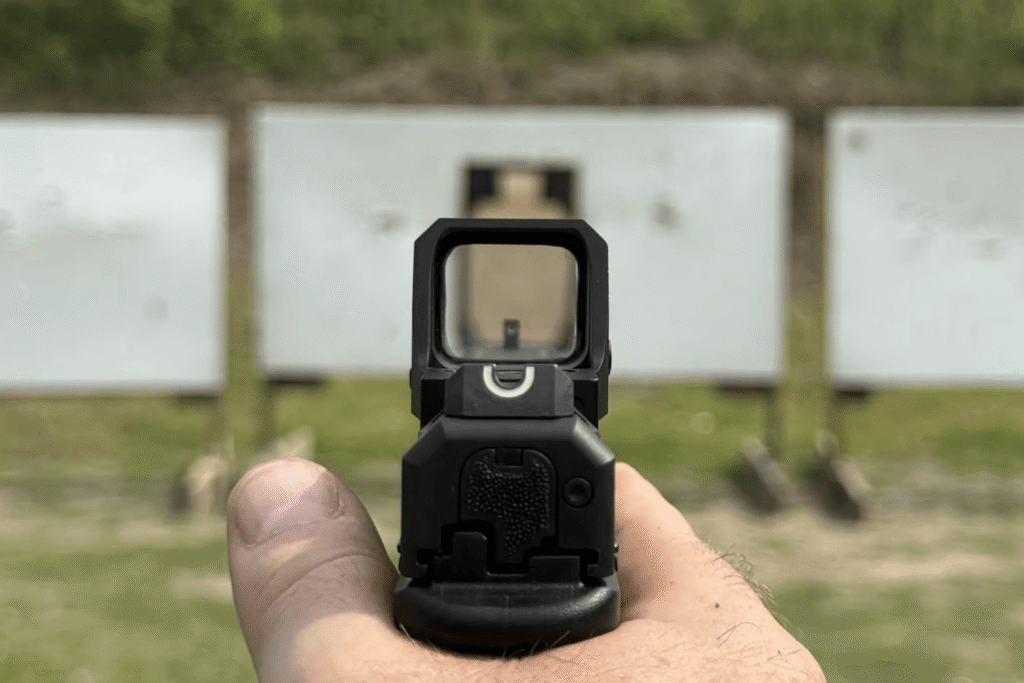
If you don’t have backup irons, or can’t use them, the next option is the guillotine technique. This method uses the optic body itself as a rough alignment tool, usually by placing the top crossbar of the optic housing across the target’s shoulder or neck line.
This is where optic shape starts to matter. On a design like the Gideon Storm, with a flat upper housing, that top edge gives a shooter a clean left‑right reference. On an optic with a more rounded housing, like the Omega, that reference is less precise and a little less intuitive.
In Mike’s demo, the guillotine method was surprisingly fast and surprisingly effective, but it also revealed its weakness. Without a good vertical reference, the shots tracked high. It worked as an emergency “get rounds on target” solution, but it wasn’t precise in the same way irons or a live dot would be.
So the guillotine technique is best treated as a close‑range emergency tool, not a replacement for a functioning optic. It’s a smart fallback, but it needs to be tested on your gun, with your optic, at realistic defensive distances.
Another failure method is the simplest one: use the optic window itself. Instead of trying to reference the dot, the irons, or the housing, you center the target inside the empty window and press the shot.
This technique is coarse. It isn’t something most shooters would choose for competition, careful shot placement, or extended distance work. In Mike’s drill, the results were clearly less refined than with a functioning dot or a deliberate iron‑sight transition.
But “less refined” isn’t the same as “useless.” In the kind of close‑range defensive scenario nobody wants but everyone should think about, a rough aiming method that keeps rounds on the attacker’s upper body is still infinitely better than freezing because the dot vanished.
The lesson: a failed optic doesn’t turn the gun into a paperweight. It just means you’re falling back to a simpler, less precise method that still gives you a chance to make accountable hits.
The ugliest method is also one of the most revealing. If the optic is completely blocked, shattered, covered in mud, or otherwise unusable, and there are no usable irons, you can still use the straight visual line formed by the slide and frame as a rough alignment reference.
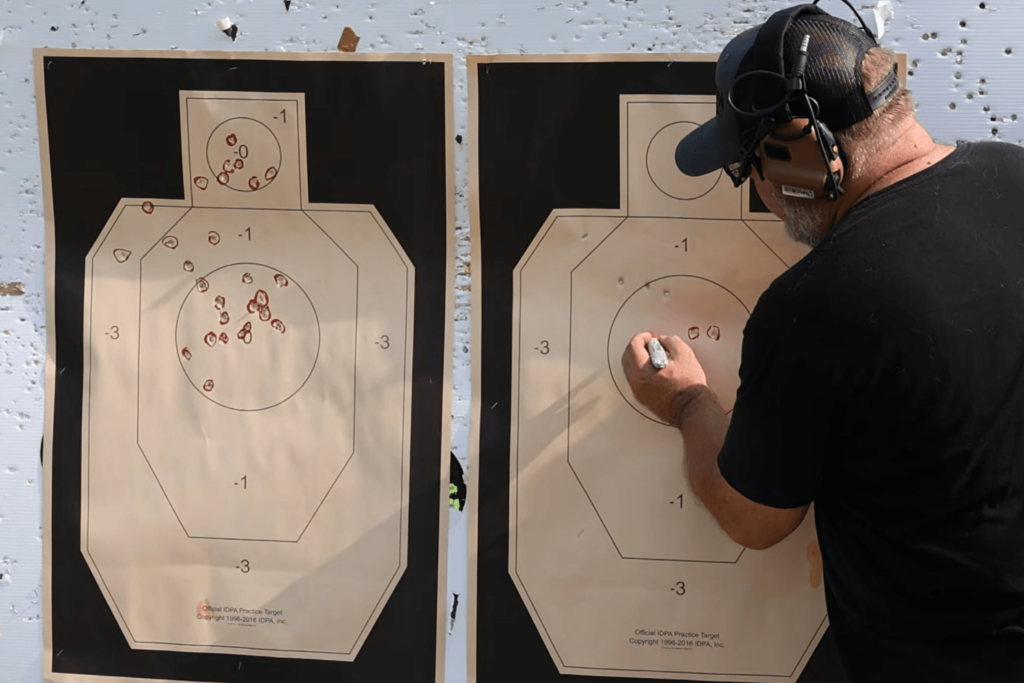
In the video, Mike rolls the pistol and uses that line in a crude but repeatable way to create left‑right alignment. It’s slow. It’s awkward. It’s absolutely not ideal.
But it worked.
Even when the top of the gun is effectively wrecked as a sighting system, a trained shooter may still be able to produce acceptable hits at defensive distances. Not fast. Not elegant. Not competition‑clean. But functional.
This is a last‑ditch solution, not a technique anyone should be excited to rely on. Still, it proves the larger point: if you’ve thought through failure ahead of time, the gun can keep doing work long after the optic stops being helpful.
The smartest takeaway from the class and the range work isn’t that red dots fail constantly. It’s that serious shooters should occasionally train for the moment one fails.
These reps shouldn’t dominate your training. Most of your work should still be with a functioning optic, because that’s how the gun is intended to be used. But adding occasional failure work gives you options, confidence, and perspective.
It also tends to make shooters more disciplined about maintenance. Once you’ve practiced failure drills, it’s a lot harder to ignore your battery schedule or assume “it’ll probably be fine.”
A failure-focused look at red dots shouldn’t create the wrong impression. The lesson isn’t that optics are fragile gimmicks. The lesson is that any tool can fail, and responsible shooters prepare for that possibility.
That’s exactly why quality still matters. A better optic gives you better performance when it’s working, fewer compromises when you’re using it hard, and more confidence that it will hold up through daily carry, range time, competition, and real use. Training for failure is smart insurance. It’s not an argument for settling for lesser equipment.
If anything, it makes the case for quality even stronger. When your pistol dot is built for real use and backed by a lifetime warranty, you should expect it to do its job. And when you’ve trained for the rare moment something goes wrong, you’re not left improvising in the middle of a problem.
A dead battery, a forgotten power setting, a cracked lens, or a blocked window doesn’t mean the fight is over. It means the shooter needs to fall back on skills that were built long before the emergency started.
Co‑witness irons are the best backup when you have them. The guillotine method, the window method, and even the slide‑line method all prove the same thing: the gun can still work, even when the dot doesn’t.
So yes, change your batteries once a year. Buy a quality pistol dot. And every once in a while, turn that dot off on purpose and make sure you still know what to do next.